Tutorial 8: Merger trees
This is the tutorial the whole series has been building toward: construct dark-matter-halo merger trees with Galacticus’s Cole et al. (2000) algorithm, walk their nodes, and read halo properties along the way — entirely from Python.
Three library capabilities combine here:
opaque object handles —
mergerTreeConstructor.constructreturns a tree as a handle you pass into other Galacticus objects;the pointer write-back protocol — tree walkers advance your node handle in place:
while walker.next(node): …;property extraction —
extractScalar(node)reads any scalar node property through thenodePropertyExtractorfamily.
The tree-building ingredients themselves are the objects from Tutorials 2, 3 and 5: the \(\sigma(M)\) chain, collapse thresholds, branching rates and root-mass sampling.
[1]:
import os, sys

# Locate the Galacticus library interface (see Tutorial 1 for details).
root = os.environ.get('GALACTICUS_LIBRARY_PATH',
                      os.path.abspath(os.path.join(os.getcwd(), os.pardir)))
os.chdir(root)   # galacticus.py loads galacticus/lib/libgalacticus.so relative to here
for candidate in (root, os.path.join(root, 'galacticus', 'python')):
    if os.path.exists(os.path.join(candidate, 'galacticus.py')):
        sys.path.insert(0, candidate)
        break
else:
    raise RuntimeError(f"galacticus.py not found under {root} - build the library "
                       "(make GALACTICUS_BUILD_OPTION=lib libgalacticus.so) or set "
                       "GALACTICUS_LIBRARY_PATH")

import ctypes
import numpy as np
import matplotlib.pyplot as plt
import galacticus
# Creating tree nodes requires the node-component class system; initialize
# it once (idempotent) with default component selections.
galacticus.nodesInitialize()
print("Galacticus library interface loaded; node system initialized.")
Galacticus library interface loaded; node system initialized.
[2]:
plt.rcParams.update({'figure.figsize': (7.0, 4.5), 'font.size': 11,
                     'axes.grid': True, 'grid.alpha': 0.3})
The object graph
Everything a Galacticus run would assemble from a parameter file, built by hand: the \(\sigma(M)\) chain (Tutorials 2–3), the Parkinson–Cole–Helly branching rates (Tutorial 5), the Cole et al. (2000) tree builder, and the tree constructor that ties them together with a root-mass sampler.
[3]:
cosmologyParameters = galacticus.cosmologyParametersSimple(0.3, 0.045, 0.7, 2.78, 70.0)
cosmologyFunctions  = galacticus.cosmologyFunctionsMatterLambda(cosmologyParameters)
darkMatterParticle  = galacticus.darkMatterParticleCDM()
transferFunction    = galacticus.transferFunctionEisensteinHu1999(
    3.046, 0.0, darkMatterParticle, cosmologyParameters, cosmologyFunctions)
linearGrowth        = galacticus.linearGrowthCollisionlessMatter(cosmologyParameters, cosmologyFunctions)
powerSpectrumPrimordial = galacticus.powerSpectrumPrimordialPowerLaw(0.965, 0.0, 0.0, 1.0, False)
powerSpectrum       = galacticus.powerSpectrumPrimordialTransferredSimple(
    powerSpectrumPrimordial, transferFunction, linearGrowth)
powerSpectrumWindowFunction = galacticus.powerSpectrumWindowFunctionTopHat(cosmologyParameters)
cosmologicalMassVariance = galacticus.cosmologicalMassVarianceFilteredPower(
    sigma8=0.8, tolerance=1.0e-4, toleranceTopHat=1.0e-4, nonMonotonicIsFatal=True,
    integrationFailureIsFatal=True, monotonicInterpolation=False,
    rootVarianceLogarithmicGradientTolerance=1.0e-4, truncateAtParticleHorizon=False,
    storeTabulations=True, cosmologyParameters_=cosmologyParameters,
    cosmologyFunctions_=cosmologyFunctions, linearGrowth_=linearGrowth,
    powerSpectrumPrimordialTransferred_=powerSpectrum,
    powerSpectrumWindowFunction_=powerSpectrumWindowFunction)
criticalOverdensity = galacticus.criticalOverdensitySphericalCollapseClsnlssMttrCsmlgclCnstnt(
    linearGrowth, cosmologyFunctions, cosmologicalMassVariance, darkMatterParticle, True)
haloMassFunction    = galacticus.haloMassFunctionShethTormen(
    cosmologyParameters, cosmologicalMassVariance, criticalOverdensity, 0.707, 0.3, 0.322183)
branchingProbability = galacticus.mergerTreeBranchingProbabilityParkinsonColeHelly(
    0.57, 0.38, -0.01, 0.1, 1.0e-6, True, True, False,
    cosmologicalMassVariance, criticalOverdensity)
randomNumberGenerator = galacticus.randomNumberGeneratorGSL(
    seed_=8675309, ompThreadOffset=False, mpiRankOffset=False)

ageToday     = cosmologyFunctions.cosmicTime(1.0)
timeEarliest = cosmologyFunctions.cosmicTime(cosmologyFunctions.expansionFactorFromRedshift(1.0e5))

# The Cole et al. (2000) tree-build algorithm (canonical parameters), with
# progenitors resolved down to 1e10 Msun.
massResolution = galacticus.mergerTreeMassResolutionFixed(1.0e10)
buildController = galacticus.mergerTreeBuildControllerUncontrolled(branchingProbability)
treeBuilder = galacticus.mergerTreeBuilderCole2000(
    0.1, 0.1,                # mergeProbability, accretionLimit
    timeEarliest, 2.0e-6,    # earliest epoch and its tolerance
    True, 1.0e-6, 1.0e-3,    # branchIntervalStep, resolution tolerances
    False, False,            # ignoreNoProgress, ignoreWellOrdering
    branchingProbability, massResolution, cosmologyFunctions,
    criticalOverdensity, cosmologicalMassVariance, buildController)

# Root masses: 8 trees, uniform in log mass over 1e12..1e13 Msun.
massDistribution = galacticus.mergerTreeBuildMassDistributionPowerLaw(0.0)
buildMasses      = galacticus.mergerTreeBuildMassesSampledDistributionUniform(
    1.0e12, 1.0e13, 8.0, massDistribution)
treeSeeds   = galacticus.mergerTreeSeedsRandom(randomNumberGenerator)
outputTimes = galacticus.outputTimesList(np.array([ageToday]), cosmologyFunctions)
treeConstructor = galacticus.mergerTreeConstructorBuild(
    ageToday, 1.0e-6, 0, True,
    cosmologyParameters, cosmologyFunctions, buildMasses, treeBuilder,
    treeSeeds, haloMassFunction, outputTimes, randomNumberGenerator)
print("tree machinery assembled.")
tree machinery assembled.
Build a tree
construct(treeNumber, finished) builds tree number \(n\) of the suite and returns it as an opaque handle (an address you never dereference in Python — you hand it to other Galacticus objects). The finished argument is a plain intent(out) logical: pass a ctypes.c_bool and read it afterwards; it turns True once the suite is exhausted. The tree’s memory is owned by Galacticus.
[4]:
finished = ctypes.c_bool(False)
tree = treeConstructor.construct(1, finished)
print(f"tree handle : {hex(tree)}")
print(f"suite done  : {finished.value}")
assert tree != 0
tree handle : 0x20722500
suite done  : False
Walk the tree and read its nodes
A mergerTreeWalker visits every node. The node argument is a ctypes.c_void_p updated in place by each call (Fortran repoints it); start it as None, loop until next returns False. At each node any scalar nodePropertyExtractor can be evaluated through extractScalar — here the basic mass and cosmic time.
[5]:
extractorMass = galacticus.nodePropertyExtractorMassBasic()
extractorTime = galacticus.nodePropertyExtractorTime()

walker = galacticus.mergerTreeWalkerIsolatedNodes(tree)
node   = ctypes.c_void_p(None)
masses, times = [], []
while walker.next(node):
    masses.append(extractorMass.extractScalar(node))
    times.append(extractorTime.extractScalar(node))
masses, times = np.array(masses), np.array(times)

print(f"nodes in tree      : {masses.size}")
print(f"root mass          : {masses.max():.3e} Msun")
print(f"earliest progenitor: t = {times.min():.2f} Gyr "
      f"(z = {cosmologyFunctions.redshiftFromExpansionFactor(cosmologyFunctions.expansionFactor(times.min())):.1f})")
assert masses.size > 10
# Terminal nodes can undershoot the resolution mass by at most the
# accretionLimit fraction (a branch halts once it drops below resolution).
assert masses.min() >= 0.999*0.9e10
assert abs(times.max()-ageToday) < 1.0e-3

plt.scatter(times, masses, s=8, alpha=0.5)
plt.yscale('log')
plt.xlabel('cosmic time [Gyr]'); plt.ylabel('halo mass [$M_\\odot$]')
plt.title(f'Every node of one merger tree ({masses.size} halos)')
plt.show()
nodes in tree      : 1207
root mass          : 8.660e+12 Msun
earliest progenitor: t = 0.60 Gyr (z = 8.3)
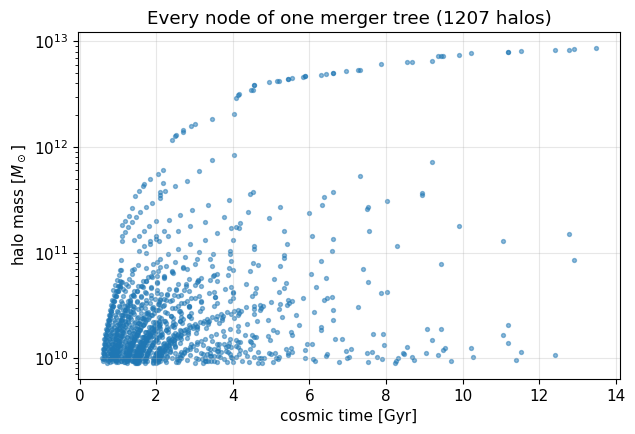
The classic wedge: many small progenitors at early times, merging into ever fewer, more massive halos — hierarchical assembly, node by node.
Assembly histories across the tree suite
Building the whole suite and tracking, at each epoch, the most massive progenitor of each tree gives (a close proxy for) the main-branch mass accretion history — steep early growth flattening toward today, with more massive trees assembling later, and tree-to-tree scatter from the stochastic branching.
[6]:
timeBins = np.linspace(1.0, ageToday, 30)
fig, ax = plt.subplots()
treeNumber, done = 0, ctypes.c_bool(False)
rootMasses, nodeCounts = [], []
while not done.value:
    treeNumber += 1
    treeN = treeConstructor.construct(treeNumber, done)
    if treeN is None or done.value:   # a null handle (None) means the suite is exhausted
        break
    walkerN = galacticus.mergerTreeWalkerIsolatedNodes(treeN)
    nodeN   = ctypes.c_void_p(None)
    m, t = [], []
    while walkerN.next(nodeN):
        m.append(extractorMass.extractScalar(nodeN))
        t.append(extractorTime.extractScalar(nodeN))
    m, t = np.array(m), np.array(t)
    rootMasses.append(m.max()); nodeCounts.append(m.size)
    # Most massive progenitor per epoch (main-branch proxy).
    history = np.array([m[t <= tb].max() if np.any(t <= tb) else np.nan
                        for tb in timeBins])
    ax.plot(timeBins, history, alpha=0.8)
ax.set_yscale('log')
ax.set_xlabel('cosmic time [Gyr]')
ax.set_ylabel('most massive progenitor [$M_\\odot$]')
ax.set_title(f'Assembly histories of {len(rootMasses)} trees')
plt.show()
for i, (mRoot, n) in enumerate(zip(rootMasses, nodeCounts), start=1):
    print(f"  tree {i}: root {mRoot:.2e} Msun, {n:4d} nodes")
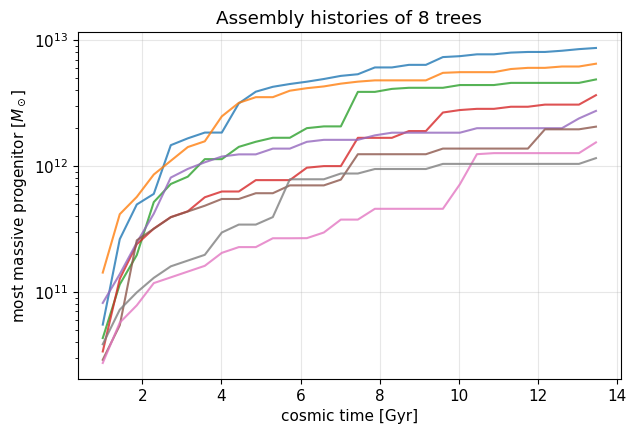
  tree 1: root 8.66e+12 Msun, 1207 nodes
  tree 2: root 6.49e+12 Msun,  747 nodes
  tree 3: root 4.87e+12 Msun,  775 nodes
  tree 4: root 3.65e+12 Msun,  577 nodes
  tree 5: root 2.74e+12 Msun,  353 nodes
  tree 6: root 2.05e+12 Msun,  324 nodes
  tree 7: root 1.54e+12 Msun,  313 nodes
  tree 8: root 1.15e+12 Msun,  168 nodes
More massive roots come with richer trees — the node count grows steeply with root mass, which is exactly the resolution/cost trade-off Tutorial 5 measured through branchingProbability.
Halo-scale physics along the walk
Node handles plug into any exposed per-node method. Here darkMatterHaloScale turns each node of our first tree into virial radii and velocities:
[7]:
virialDensityContrast = galacticus.virialDensityContrastSphericalCollapseClsnlssMttrCsmlgclCnstnt(
    True, cosmologyFunctions)
darkMatterHaloScale = galacticus.darkMatterHaloScaleVirialDensityContrastDefinition(
    cosmologyParameters, cosmologyFunctions, virialDensityContrast)

walker = galacticus.mergerTreeWalkerIsolatedNodes(tree)
node   = ctypes.c_void_p(None)
radii, velocities = [], []
while walker.next(node):
    radii     .append(darkMatterHaloScale.radiusVirial  (node))
    velocities.append(darkMatterHaloScale.velocityVirial(node))
radii, velocities = np.array(radii), np.array(velocities)

plt.scatter(1.0e3*radii, velocities, s=8, alpha=0.5, c=times, cmap='viridis')
plt.colorbar(label='cosmic time [Gyr]')
plt.xscale('log'); plt.yscale('log')
plt.xlabel('virial radius [kpc]'); plt.ylabel('virial velocity [km/s]')
plt.title('Virial scaling across one tree, colored by epoch')
plt.show()
print(f"root halo: R_vir = {1.0e3*radii[times.argmax()]:.0f} kpc, "
      f"V_vir = {velocities[times.argmax()]:.0f} km/s")
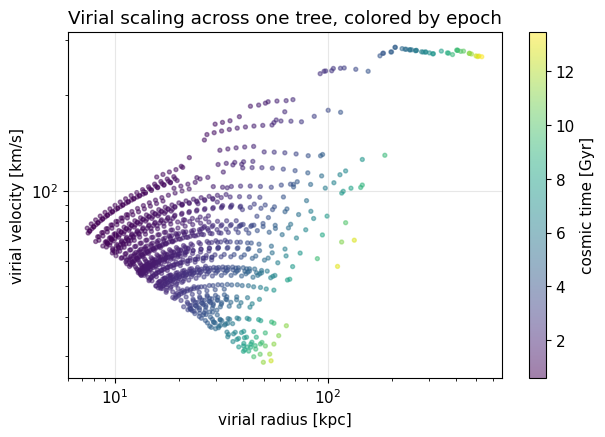
root halo: R_vir = 530 kpc, V_vir = 265 km/s
Practical notes
Initialization: call
galacticus.nodesInitialize()once before any tree or node is created (the setup cell here does it).Handles are Fortran-owned: tree and node handles are addresses into Galacticus’s memory. Don’t use a node handle after its tree has been rebuilt or destroyed; trees built here live until the process exits.
Determinism: the tree suite is reproducible through the random number generator’s seed.
Where next: everything downstream of tree building — evolving the galaxies inside these halos — is the job of
Galacticus.exeand itsnodeOperator/mergerTreeEvolvermachinery; see the user guide for the parameter files that do what this notebook did, at scale.